What to Expect During Medical Treatment in China: Registration, Tests & Hospital Stays

You’ve reached the hospital with your appointment message and passport. The building is busy, several counters look almost identical, and the doctor who will treat you is somewhere upstairs. What should you do first?
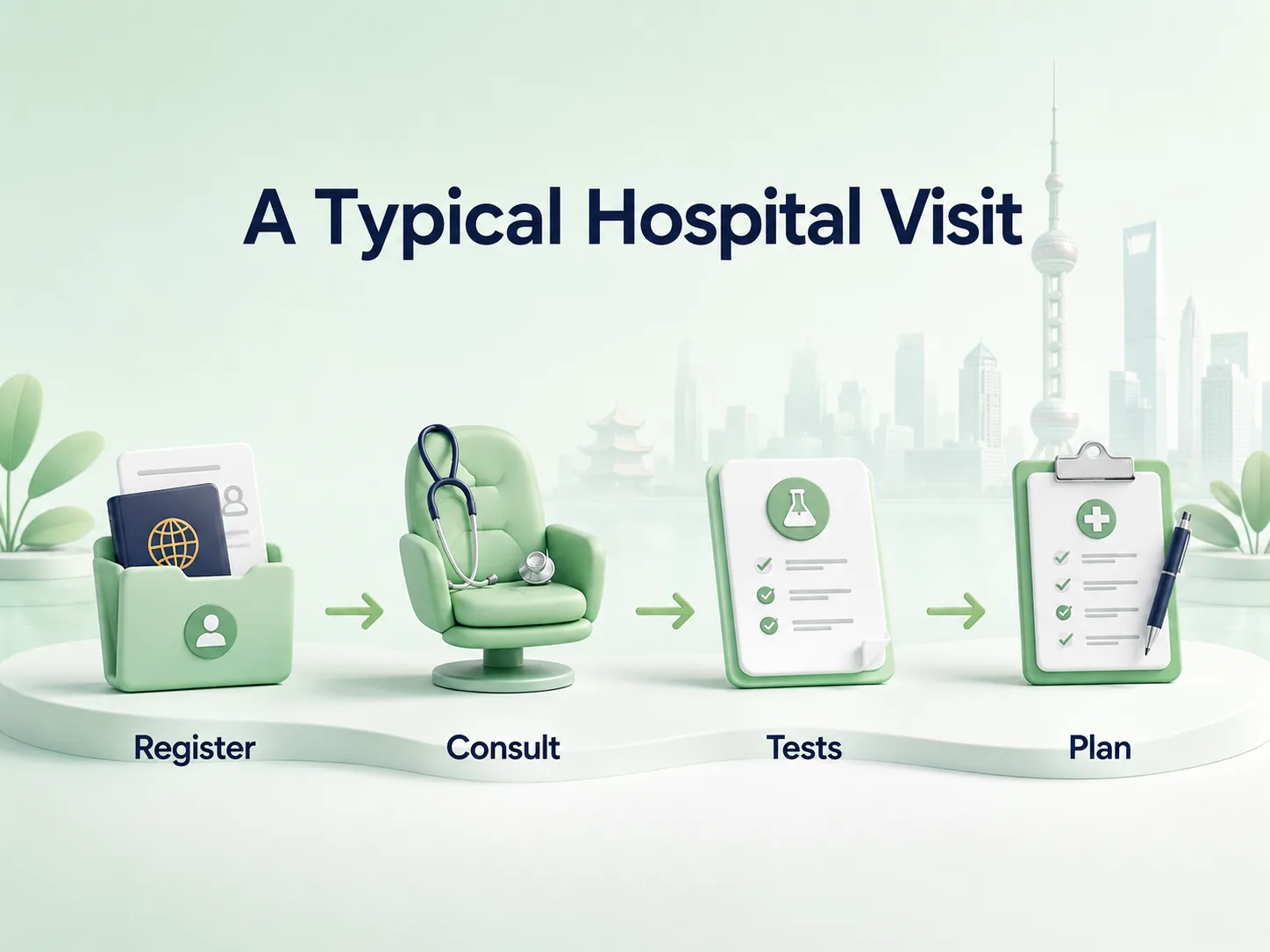
In many Chinese hospitals, one visit involves several separate steps: identity registration, appointment check-in, payment, consultation, tests, another payment and a return to the doctor. Staff may expect you to move between these steps yourself. Knowing the order makes the experience much easier. This guide is part of our series on planning a medical trip to China.
Medical disclaimer: This guide explains common hospital procedures and is not medical advice. Processes vary by hospital and treatment. Follow the instructions from your hospital and medical team. For a medical emergency in China, call 120 or go to the nearest emergency department.
Confirm the Department Before You Enter the Queue
Large Chinese hospitals are divided into specialist departments. The hospital name alone is not enough; you need the correct campus, building, department and doctor.
Before leaving your hotel, save these details in both English and Chinese:
-
hospital name and campus;
-
entrance or building;
-
department and doctor;
-
appointment date and time;
-
international patient office telephone number;
-
name of your hospital coordinator or interpreter.
A hospital may have multiple campuses across a city. Going to the right hospital but the wrong campus can cause you to miss the appointment. Use DiDi or a taxi with the campus address saved in Chinese, or check our public transport guide if you plan to take the metro.
If you arranged treatment from overseas, ask where foreign patients should register. Some hospitals direct international patients to a dedicated service center; others use the ordinary outpatient registration system. If you haven’t booked yet, start with how to contact and book a Chinese hospital before you travel.
Step 1: Register with Your Passport
Your passport is the main identity document for hospital registration. Bring the original document, not only a photo on your phone. The name used by the hospital should match the passport spelling because the same identity may appear on test results, prescriptions, invoices and insurance documents.
At a first visit, staff may create a hospital patient number, medical record or physical patient card. You may be asked for a local or overseas phone number, date of birth, address and emergency contact.
Beijing’s official guide for foreign patients describes appointment and registration services and shows that the exact route differs between medical institutions. Peking Union Medical College Hospital, for example, lists its own app, WeChat mini program and telephone channels for international services. Don’t assume one national app works for every hospital.
Check the details immediately. If your name, sex, birth date or passport number is wrong, ask staff to correct it before testing.
我是第一次来,请问外国患者在哪里登记?
Wǒ shì dì yī cì lái, qǐngwèn wàiguó huànzhě zài nǎlǐ dēngjì?
This is my first visit. Where should a foreign patient register?
Step 2: Check In and Pay the Consultation Fee
Registration and appointment check-in are related but not always the same step. You may already have a reservation but still need to confirm arrival at a machine, counter, app or nursing desk.
Bring the booking confirmation and arrive earlier than the appointment time. International departments may give you a specific arrival time for document checks or interpretation.
Depending on the hospital, you may pay the consultation fee when booking, at check-in or at a cashier. Keep the receipt and check which waiting area is shown on the ticket or app. Our guide to medical costs in China for international patients explains deposits, top-ups and accepted payment methods, and how to pay in China covers setting up Alipay and WeChat Pay.
Doctor schedules can shift when consultations take longer or an urgent case arrives. Don’t book a train or sightseeing ticket immediately after a hospital appointment.
Step 3: Prepare for the Consultation
Give the doctor a short, organized medical summary instead of opening dozens of files during the appointment.
Prepare:
-
your main diagnosis or reason for treatment;
-
when the symptoms began and how they changed;
-
previous operations and major illnesses;
-
current medicines, doses and schedules;
-
drug, food and material allergies;
-
relevant test results and imaging;
-
the questions you need answered before agreeing to treatment.
Keep the original records, but prepare a smaller “doctor set” containing the most relevant pages. If the documents are not in Chinese or English, ask the hospital whether translation is required. Our checklist of what to prepare before traveling to China for medical treatment shows how to organize those records.
Never stop, replace or double a medicine because of a translation misunderstanding. Show the packaging or a clear photo and ask the doctor to write down any change.
这是我现在使用的药物和剂量。
Zhè shì wǒ xiànzài shǐyòng de yàowù hé jìliàng.
These are my current medicines and doses.
我对这种药物过敏。
Wǒ duì zhè zhǒng yàowù guòmǐn.
I am allergic to this medicine.
Step 4: Pay for Tests Before Going to the Test Area
After the consultation, the doctor may order laboratory tests, imaging, pathology or another specialist review. In many hospitals, an order must be paid before the test department can process it.
Before leaving the consultation area, ask:
-
Do I need to pay now?
-
Do I need an appointment for this test?
-
Must I fast or stop any medicine?
-
Where is the test performed?
-
When and where will the result appear?
-
Do I return to this doctor with the result?
Never fast, stop medication or change insulin based only on a general internet guide. Follow the instructions issued for your exact test and confirm anything unclear with the medical team.
CT, MRI, ultrasound, blood collection and other tests may be in different buildings. Some results may appear in an app or mini program; others may require a printed report or collection from a machine. Imaging films and the written radiology report are separate items, so ask which one the doctor needs.
Step 5: Return for the Doctor’s Decision
Completing a test does not always mean the doctor automatically contacts you. You may need a follow-up appointment or a return number on the same day.
Before leaving the test area, confirm:
-
whether all results are complete;
-
whether the doctor can see them electronically;
-
when you should return;
-
whether you need another registration fee;
-
whether an interpreter has been booked.
If pathology or specialized laboratory work takes several days, don’t assume the date based on a routine blood-test turnaround. Ask for the expected reporting date and who will explain the result.
What Happens If You Are Admitted to Hospital
If the doctor recommends inpatient treatment, you will usually receive an admission notice and instructions for the inpatient office. Planned admission may depend on bed availability, completion of tests and payment of a deposit.
At admission, the hospital may ask for:
-
original passport;
-
admission notice;
-
patient number or hospital card;
-
insurance authorization if applicable;
-
deposit payment;
-
contact details for a companion;
-
signed consent documents.
Ask whether your companion can remain in the ward and whether a hospital-approved caregiver is available. Ward visiting and overnight companion rules differ by hospital and department.
Bring your medication list, but don’t take medicines from your suitcase without telling the ward team. The doctors need to know everything you are taking to avoid duplication or interactions.
For any procedure, request interpretation before signing if you do not fully understand the consent form. Ask the doctor to explain the purpose, important risks, alternatives, recovery plan and what could cause the treatment to change.
Payment During a Hospital Stay
The billing office may deduct daily charges from your admission deposit. If the balance falls below the hospital’s required level, you may receive a top-up request.
Keep a record of each payment. If someone asks you to send money through an unfamiliar QR code or personal bank account, verify the request directly with the hospital cashier or international patient office.
Insurance direct billing does not necessarily cover every item. Non-covered medication, private rooms, meals, interpretation or upgraded devices may remain your responsibility.
Before You Leave the Hospital
Discharge is not just walking out of the ward. You may need to complete the bill, collect medicine, arrange follow-up and request documents.
Before leaving, obtain:
-
discharge summary;
-
diagnosis certificate;
-
operation or treatment record where applicable;
-
laboratory and imaging reports;
-
pathology report where applicable;
-
medication list with dose and duration;
-
follow-up date and department;
-
wound-care or rehabilitation instructions;
-
official invoice and itemized bill;
-
emergency contact or instructions for warning signs.
Ask which documents can be issued in English. If the hospital only provides Chinese records, arrange translation before submitting them to an overseas doctor or insurer. Our guides to recovering in China after medical treatment and before you leave China cover the recovery period and the final records handover.
请写清楚复诊时间、用药方法和需要注意的症状。
Qǐng xiě qīngchu fùzhěn shíjiān, yòngyào fāngfǎ hé xūyào zhùyì de zhèngzhuàng.
Please write down the follow-up time, how to take the medicine and the symptoms I should watch for.
If You Need Emergency Care
Don’t continue following an outpatient appointment plan during a medical emergency. Call 120 or go to the nearest emergency department. Beijing’s official medical guide confirms 120 as the emergency medical number and notes that hospital emergency departments can provide urgent care.
Save your hotel address and hospital address in Chinese. If you cannot explain the situation by phone, ask hotel staff, a local contact or a nearby person to help call 120.