What to Prepare Before Traveling to China for Medical Treatmen
Your hospital appointment is confirmed, and you’re starting to look at flights. At this point, it’s easy to focus on normal travel questions: where to stay, how to pay and what to do after arriving.
A medical trip needs a different kind of preparation.
You need your passport, but you also need records that the doctor can actually review. You need medication for the journey, but you must check whether it can legally enter China. You may have a hospital date, but that doesn’t always mean your admission or treatment date has been confirmed.
This guide explains what to prepare for medical treatment in China before you leave home.
Medical disclaimer: This article is for informational purposes only and does not constitute medical advice. Ask your treating doctor whether you’re medically fit to travel. In an emergency in China, call 120 or go to the nearest emergency department.
Confirm What the Hospital Has Actually Booked
Before paying for a non-refundable flight, check the hospital’s written confirmation.
It should show:
-
your full name as written in your passport;
-
the hospital and exact campus;
-
the department;
-
the appointment date;
-
the arrival or check-in time;
-
the doctor or medical team, if specified;
-
the type of appointment;
-
documents and test results to bring;
-
payment or deposit instructions;
-
an official contact person or service desk.
A confirmed consultation doesn’t automatically mean you have a hospital bed, procedure date or treatment approval.
The usual sequence may be:
-
Medical records are reviewed.
-
An outpatient consultation is booked.
-
You arrive and complete registration.
-
The doctor examines you.
-
Additional tests are performed.
-
A treatment plan is confirmed.
-
Admission or a procedure is scheduled.
If your confirmation is unclear, follow our guide on how to contact and book a Chinese hospital before you travel before buying flights.
Prepare Your Passport and Entry Documents
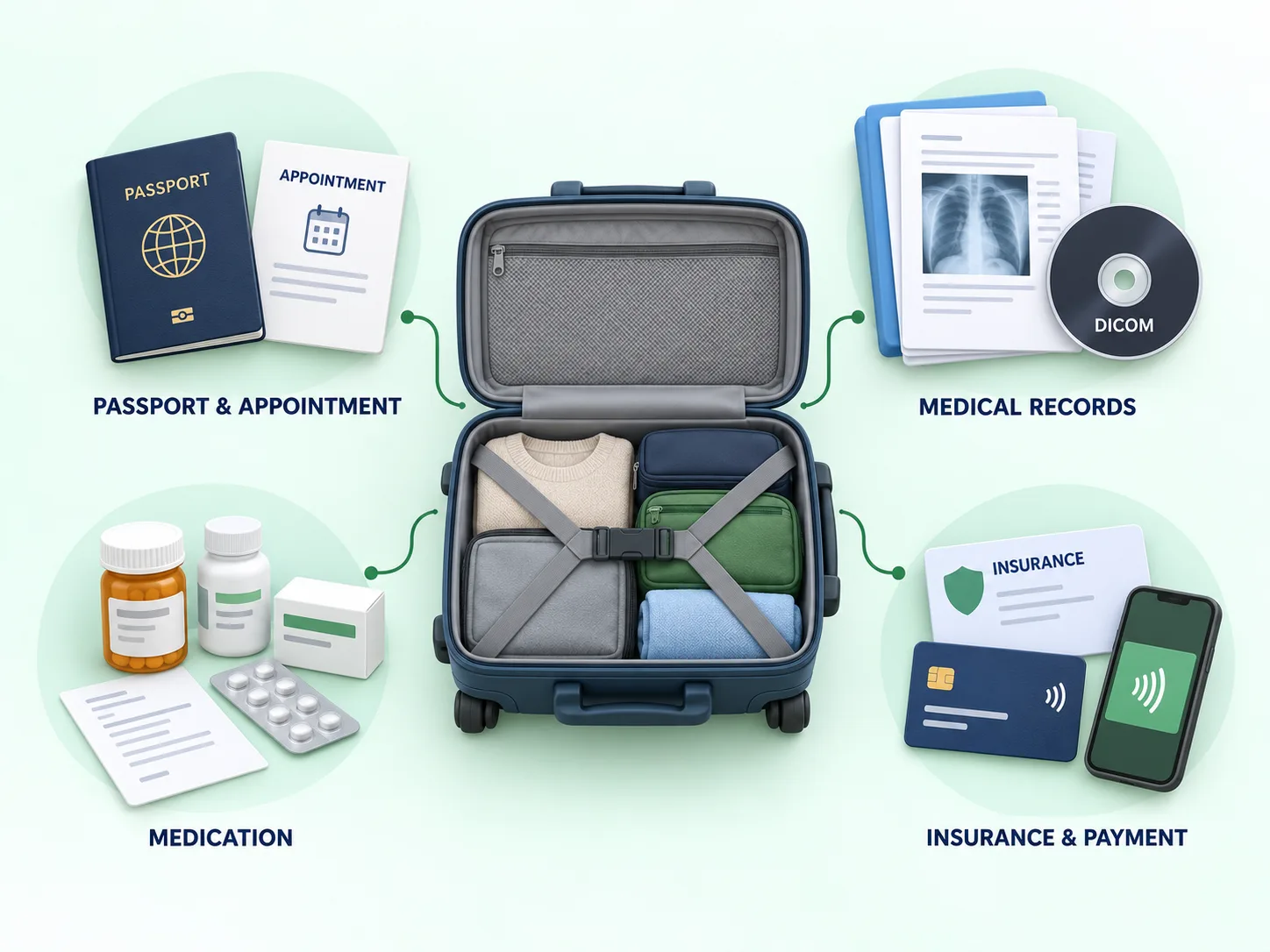
Carry your original passport in your hand luggage.
For a short-term foreign patient, the passport is normally the main document used to verify identity at hospitals, hotels and transport services. Some hospitals may accept other valid international travel documents, but you should confirm this in advance.
Check:
-
passport validity;
-
blank visa pages if you’re applying for a visa;
-
the spelling of your name on the hospital appointment;
-
your visa or confirmed visa-free eligibility;
-
permitted purpose of entry;
-
allowed duration of stay;
-
number of entries;
-
accommodation information;
-
return or onward travel arrangements.
Don’t assume that visa-free tourism rules automatically cover a planned medical trip. Read our 2026 guide to visas for medical treatment in China and verify your situation with the responsible Chinese embassy, consulate or visa application center.
Bring printed and digital copies of:
-
passport information page;
-
Chinese visa, if applicable;
-
hospital invitation or pre-admission document;
-
appointment confirmation;
-
accommodation booking;
-
travel itinerary;
-
insurance certificate;
-
emergency contacts.
Store a secure copy online and another copy offline on your phone.
Create a One-Page Medical Summary
The doctor shouldn’t have to search through dozens of files to understand your condition.
Prepare a concise medical summary containing:
-
full name and date of birth;
-
confirmed diagnosis;
-
date of diagnosis;
-
current symptoms;
-
previous procedures or operations;
-
major test results;
-
current medications and dosages;
-
medication allergies;
-
other medical conditions;
-
implanted medical devices;
-
reason for seeking treatment in China;
-
contact details for your doctor at home.
Use generic medicine names where possible, not only local brand names.
If the patient has several conditions, place the most important one first but don’t hide the others. Heart disease, kidney disease, diabetes, bleeding disorders and previous reactions to anesthesia may affect treatment planning.
Organize Your Medical Records
Create separate folders instead of sending or carrying a collection of unnamed photographs.
A practical structure is:
| Folder | Documents |
|---|---|
| Medical Summary | One-page patient summary |
| Doctor Reports | Referral letters and specialist reports |
| Laboratory Results | Blood tests and other laboratory reports |
| Imaging | CT, MRI, X-ray and ultrasound reports |
| DICOM Files | Original digital imaging files |
| Pathology | Pathology reports and review information |
| Previous Treatment | Operation and discharge records |
| Medication | Current medicine and allergy list |
| Insurance | Policy and authorization documents |
Use clear file names:
CT_Chest_2026-07-18.pdf
not:
IMG_4826.jpg
Ask the Chinese hospital whether it needs:
-
original reports;
-
certified translations;
-
recent repeat tests;
-
DICOM imaging files;
-
pathology slides or blocks;
-
physical discs;
-
a secure upload link.
Don’t ship pathology samples or other medical material until the hospital gives you specific instructions.
Translate the Important Documents
International medical departments may accept English records, but this isn’t guaranteed at every hospital or department.
Ask what language is required.
Prioritize translation of:
-
diagnosis;
-
medical summary;
-
operation report;
-
pathology report;
-
important imaging conclusions;
-
discharge summary;
-
current medications;
-
allergy history.
Keep the original and translated versions together.
Automatic translation can be useful for a basic enquiry, but it shouldn’t be relied on for medication dosage, pathology findings, consent documents or surgical risks.
Prepare Medication Carefully
Bring enough regular medication for the planned stay and a reasonable delay, subject to customs rules and your doctor’s instructions.
Keep medicines:
-
in their original packaging;
-
clearly labelled;
-
together with the prescription;
-
with a doctor’s letter explaining their medical purpose;
-
in your hand luggage where airline rules permit.
The doctor’s letter should use generic medicine names and include the dosage.
China Customs states that articles carried by international passengers must be for personal use and within a reasonable quantity. This does not mean every medication can enter automatically. Controlled, narcotic, psychotropic, injectable or temperature-sensitive medicines may require additional checks.
Before travelling, confirm requirements with:
-
the Chinese embassy or consulate responsible for your location;
-
China Customs;
-
your airline;
-
the hospital in China.
Don’t transfer prescription medicine into an unlabelled box.
If a medicine requires refrigeration, prepare:
-
an airline-approved cooling method;
-
a temperature-monitoring plan;
-
written handling instructions;
-
storage confirmation from your hotel or recovery accommodation;
-
a backup plan in case of delay.
Don’t assume the same brand or formulation will be available in China.
Carry a Medication and Allergy Card
Create a printed card containing:
-
medical condition;
-
medicine name;
-
dosage;
-
time taken;
-
serious allergies;
-
implanted device;
-
emergency contact;
-
treating hospital;
-
insurance assistance number.
An English and Chinese version is more useful than English alone.
You can show hospital staff:
这是我目前服用的药物和过敏记录。请不要在确认之前更改我的用药。
Zhè shì wǒ mùqián fúyòng de yàowù hé guòmǐn jìlù. Qǐng búyào zài quèrèn zhīqián gēnggǎi wǒ de yòngyào.
These are my current medications and allergy records. Please don’t change my medication before confirming it.
Never stop or change medication because of general travel advice. Follow instructions from your qualified medical team.
Confirm Costs, Deposits and Payment Methods
Ask the hospital for written information about:
-
consultation fee;
-
international service fee;
-
interpreter fee;
-
likely tests;
-
estimated treatment range;
-
inpatient deposit;
-
accepted bank cards;
-
mobile payment options;
-
cash payment;
-
refund rules;
-
documents available for insurance claims.
A pre-arrival estimate isn’t a guaranteed final bill. The treatment plan may change after examination or new tests.
Contact your bank before travelling and check:
-
overseas transaction permissions;
-
daily card limits;
-
online payment limits;
-
fraud controls;
-
emergency contact numbers.
Prepare more than one payment method. Don’t rely entirely on one international card or one mobile payment account.
Check Your Insurance Before Departure
Ask your insurer whether the planned treatment is covered. Ordinary travel insurance often excludes:
-
planned medical treatment;
-
pre-existing conditions;
-
elective procedures;
-
routine follow-up;
-
medical complications related to excluded treatment.
Request written confirmation rather than relying on a telephone conversation.
Confirm whether the policy uses:
-
Direct billing: the hospital bills the insurer directly;
-
Pay and claim: you pay first and request reimbursement later.
Direct billing only works when the hospital, insurer and specific policy have an applicable arrangement.
Ask what documents you must collect, such as:
-
official invoice;
-
itemized bill;
-
diagnosis certificate;
-
medical report;
-
prescription;
-
discharge summary;
-
payment receipt;
-
insurance claim form.
Decide Who Will Travel with You
A companion may be more useful than an ordinary travel partner.
They may need to:
-
communicate with the hospital;
-
carry documents;
-
arrange payment;
-
collect medicine;
-
contact your family;
-
help after discharge;
-
change accommodation or flights;
-
speak on your behalf if permitted.
Ask the hospital whether it needs written authorization before sharing information with your companion.
The companion should carry:
-
their own passport and entry documents;
-
proof of relationship if required for the visa;
-
hospital confirmation naming them as the companion, if provided;
-
the patient’s emergency contacts;
-
copies of the treatment itinerary.
Book Accommodation Near the Correct Campus
Large hospitals may operate several campuses. A hotel near the hospital’s general address may still be far from the department you need.
Check the exact Chinese address before booking.
For the early treatment and recovery period, prioritize:
-
short travel time to the hospital;
-
elevator access;
-
step-free entrance;
-
a quiet room;
-
nearby food and pharmacy options;
-
refrigerator access if medically required;
-
flexible cancellation;
-
room for a companion;
-
taxi or DiDi pickup access.
If you stay in a hotel, the hotel normally handles accommodation registration using your passport. If you stay in a private home or other non-hotel accommodation, separate registration requirements apply. China introduced an online accommodation-registration pilot in several regions in March 2026, but coverage isn’t yet identical nationwide.
Ask your host or local public security office what applies at the actual address.
Set Up Communication Before Arriving
Save these details in both English and Chinese:
-
hospital name;
-
hospital campus;
-
department;
-
hospital address;
-
coordinator’s name;
-
hospital telephone number;
-
hotel address;
-
emergency contact;
-
insurer’s assistance number.
Install and test any apps you plan to use for:
-
translation;
-
maps;
-
mobile payment;
-
taxi or DiDi;
-
messaging;
-
hospital communication.
Keep the hospital appointment available offline. Don’t rely on mobile data working immediately after landing.
A portable charger and a second payment method are simple but useful backups.
Leave Space for Treatment and Recovery
Don’t build a fixed sightseeing schedule around an estimated discharge date.
Your doctor may order new tests, change the procedure date or recommend a longer recovery period.
Use flexible accommodation and flights where practical. Keep the first days after treatment free of tourism.
The correct sequence is:
Treatment → Medical observation → Recovery → Follow-up → Doctor clearance → Travel
Only begin sightseeing if the treating doctor says it’s medically appropriate. A short city walk may still be unsuitable after surgery, anesthesia or a change in medication.
Prepare an Emergency Plan
Save:
-
120for medical emergencies in China; -
your hospital’s emergency number;
-
the nearest emergency department;
-
your hotel’s Chinese address;
-
your companion’s number;
-
your insurer’s emergency line;
-
your home doctor’s contact.
Prepare a short Chinese emergency card:
我是外国患者,正在中国接受治疗。这是我的诊断、药物和过敏记录。请帮我联系这家医院。
Wǒ shì wàiguó huànzhě, zhèngzài Zhōngguó jiēshòu zhìliáo. Zhè shì wǒ de zhěnduàn, yàowù hé guòmǐn jìlù. Qǐng bāng wǒ liánxì zhè jiā yīyuàn.
I’m an international patient receiving treatment in China. These are my diagnosis, medications and allergy records. Please help me contact this hospital.
Final Check 48 Hours Before Departure
Confirm:
- Passport and correct visa or entry permission
- Written hospital appointment
- Correct hospital campus and department
- Original medical records
- Translated key documents
- Imaging and pathology requirements
- Medication and prescription letter
- Insurance authorization
- Hospital payment plan
- Companion documents
- Recovery accommodation
- Hospital address in Chinese
- Mobile data and payment backups
- Flexible return arrangements
- Emergency contact card
If the hospital appointment, entry permission or medication arrangements remain unclear, resolve them before flying.
FAQ
Do I need my original passport at a Chinese hospital?
Should I translate all my medical records into Chinese?
Ask the hospital which documents it needs translated. Start with the diagnosis, medical summary, operation report, pathology report, major test results, medication list and allergies.
Can I bring prescription medicine into China?
Carry original packaging, a prescription and a doctor’s letter, and confirm controlled or unusual medicines with the relevant Chinese authorities before travelling.
Should I book tourism activities before treatment?
Leave the recovery period flexible. Book tourism only after treatment and after your doctor confirms that the planned activity is appropriate.