How to Travel in China Safely After Medical Treatment
Your treatment is finished, you feel better, and there are several places in China you would still like to see. But “better” is not a travel clearance.
Before booking a high-speed train, climbing steps at a historic site or taking a long flight home, turn your doctor’s recovery advice into a practical travel plan. The safest post-treatment trip is usually shorter, slower and easier to change than the itinerary you would choose before treatment. This guide follows on from recovering in China after medical treatment.
Medical disclaimer: This article provides general travel-planning information and does not replace advice from your treating clinician, airline or insurer. Do not travel against medical advice. For an emergency in China, call 120 or go to the nearest emergency department.
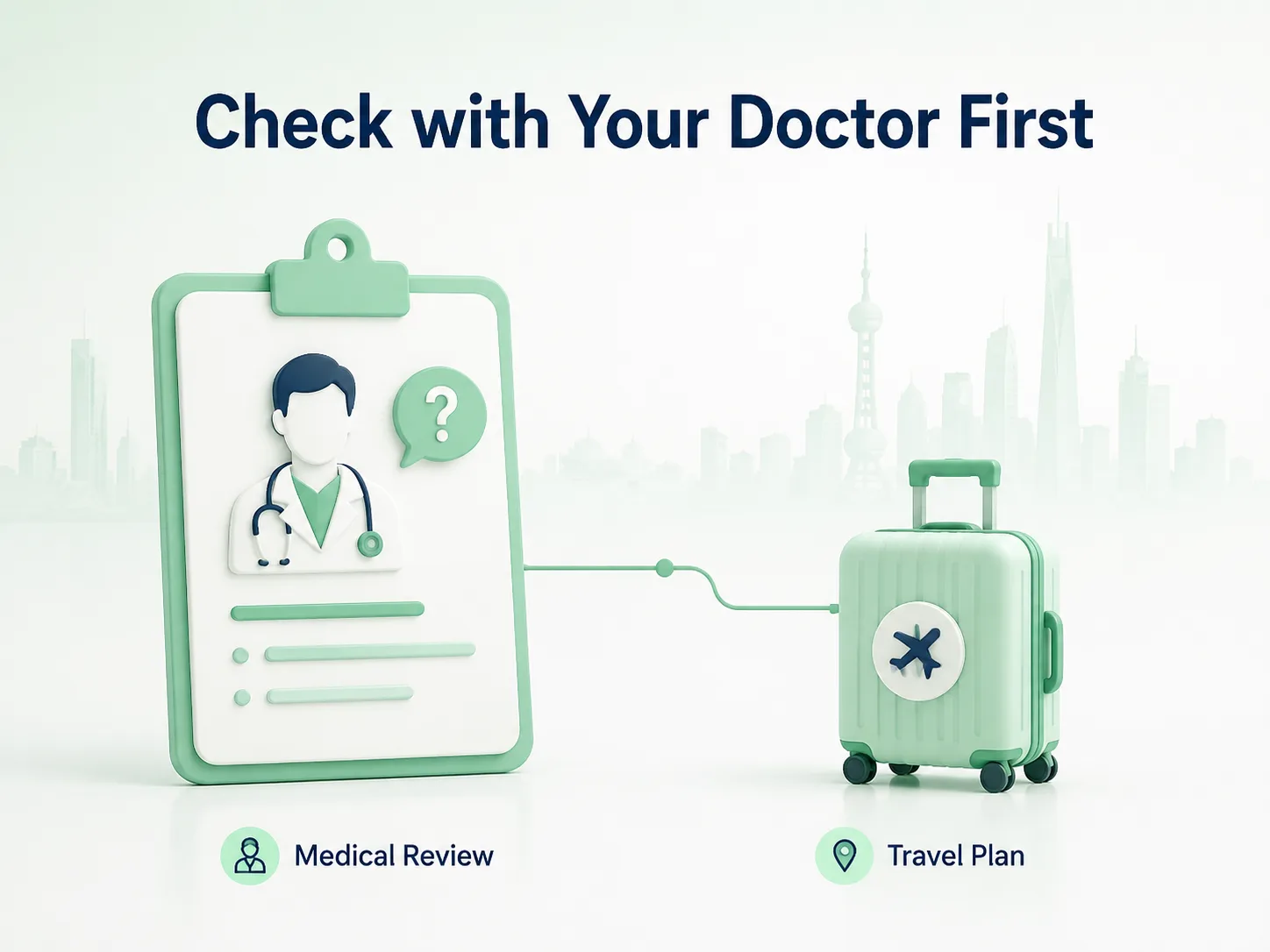
Discharged, Fit for Sightseeing and Fit to Fly Are Different
Leaving hospital means you no longer need that level of inpatient care. It does not automatically mean you can spend a full day walking or sit on a long flight.
Before changing cities, ask the treating doctor to assess the actual journey:
-
How long will you sit in a car, train or plane?
-
How much walking and standing are required?
-
Will you carry or lift luggage?
-
Are there stairs, heat, altitude or large crowds?
-
Can you return quickly if a symptom changes?
-
Will you miss a follow-up test or medication time?
Ask for written guidance, especially if an airline, insurer or next hospital may request it.
我可以坐高铁或飞机吗?请写在证明上。
Wǒ kěyǐ zuò gāotiě huò fēijī ma? Qǐng xiě zài zhèngmíng shàng.
Can I take a high-speed train or flight? Please include it in the certificate.
Get a Specific Medical Clearance
Avoid a vague question such as “Can I travel?” Ask separately about:
-
short local outings;
-
travel to another Chinese city;
-
high-speed rail;
-
domestic flights;
-
the international flight home;
-
planned activities at the destination.
The answer may be different for each one. A person may be able to take a 20-minute car ride but not a long train journey. Someone may be able to walk on level ground but not climb a historic site with many steps.
The CDC warns that surgery and air travel independently increase the risk of blood clots, and travelling during recovery can add other risks. There is no single safe waiting period for every procedure and patient. Use the treating clinician’s assessment and the airline’s rules.
Build a Low-Intensity China Itinerary
Choose one main activity per day, keep it close to your accommodation and make cancellation easy.
A practical recovery-day plan may look like this:
-
breakfast and medication at the usual time;
-
a short car ride outside rush hour;
-
one accessible attraction with seating and toilets;
-
a planned rest before you feel exhausted;
-
return to the hotel early;
-
no evening booking that forces you to continue.
Avoid combining several “nearby” attractions just because they appear close on a map. Large railway stations, museums and scenic areas can require much more walking than expected.
Check accessibility directly with the attraction. “Wheelchair accessible” may describe the main entrance but not every exhibition, garden or viewpoint.
Stay Close to Medical Support at First
Your first outing should not take you far from the treating hospital. Keep its Chinese name, campus, emergency entrance and telephone number saved on every companion’s phone.
If you later travel to another city, identify a suitable hospital there before departure. Our hospital directory lists Grade 3A hospitals by city, with the international service each one offers. Bring a concise medical summary, not only hundreds of unorganized images.
Carry:
-
passport;
-
discharge summary and recent medical certificate;
-
current medication list;
-
allergy information;
-
essential medicine in original packaging;
-
treating hospital contact;
-
insurance assistance number;
-
companion’s contact details.
Do not leave the only copy of your medical records in checked luggage.
Choose the Easiest Local Transport
During early recovery, a direct car journey may be easier than a crowded metro with transfers and long station corridors.
When using DiDi or a taxi:
-
enter the exact Chinese destination and gate;
-
allow time for the vehicle to reach the hospital pickup area;
-
request a suitable vehicle if you have a folding wheelchair or large medical equipment;
-
ask hotel or hospital staff to confirm the pickup point.
If you use the metro, check for elevators and accessible gates before travelling. Avoid rush hour when possible and don’t assume every exit has step-free access. Our guide to public transport in China explains how metro QR codes and accessible gates work.
Taking a High-Speed Train After Treatment
High-speed rail can avoid airport pressure changes and may offer easier city-center access, but it still involves walking, security, waiting and sitting.
Before booking:
-
confirm the doctor agrees with the journey length;
-
choose the exact departure and arrival stations;
-
select a direct train when possible;
-
allow extra time for security and boarding;
-
request railway assistance if needed;
-
keep medication and records in hand luggage;
-
arrange transport from the arrival station.
Large stations can be physically demanding. Don’t judge the journey only by the time shown on the train ticket. See our guides on taking high-speed trains in China and booking tickets on the 12306 English app for station procedures and passport check-in.
Flying After Medical Treatment
Air travel needs a separate check with the doctor and airline. Cabin pressure, reduced oxygen, long periods of sitting and limited access to care may matter after certain procedures or during active illness.
Contact the airline before buying a non-refundable ticket if you recently had surgery, need oxygen, require a wheelchair, cannot sit upright normally or need help during boarding.
Airline documentation rules vary. China Eastern’s current guidance for sick passengers, for example, says certain travellers may need a fitness-to-fly, diagnosis or post-operative certificate. Its page specifies requirements for the date, hospital level, stamp and doctor’s signature. That is China Eastern’s rule, not a universal rule for every airline, so check the carrier operating your flight.
Medical clearance from a doctor and acceptance by an airline are also separate. A doctor may consider you clinically stable while an airline still requires forms or advance arrangements.
If you need a wheelchair, portable oxygen concentrator, stretcher or other assistance, request it within the airline’s stated deadline and wait for confirmation. Submitting a request does not necessarily mean it has been approved.
Reduce Long-Journey Risks
Follow the treatment team’s instructions for movement, hydration, compression garments and medication. Do not start aspirin, anticoagulants or another medicine solely because you are taking a long trip.
Recent surgery, hospitalization, cancer treatment and previous blood clots are among the factors that can increase travel-related clot risk. The CDC advises travellers to seek urgent care for possible clot symptoms such as unexplained swelling or pain in a limb, sudden breathing difficulty, chest pain, coughing blood, fainting or a very fast heartbeat.
These symptoms require medical assessment; they are not something to manage by changing the itinerary.
Avoid Heat, Altitude and Physically Demanding Attractions
China’s destinations vary greatly. A summer walking route in Shanghai, steep sections of the Great Wall and a high-altitude trip are not equivalent “light tourism.”
Ask the clinician whether your planned destination creates a specific concern. If you are still recovering, prioritize level routes, indoor temperature-controlled attractions, frequent seating and easy vehicle access. Our China attractions directory links to each site’s official page, and how to book attraction tickets with a foreign passport explains reservations.
Don’t add a high-altitude destination after treatment without discussing it with the medical team. Lower oxygen levels and limited access to specialist care may make the trip unsuitable for some conditions.
Keep Food and Medication Predictable
Travel days can disrupt meal and medication times. Set alarms, carry an allowed supply in hand luggage and keep water or food available when the prescription requires it.
If medicine needs refrigeration, ask the pharmacy for the permitted storage range and a transport plan. A hotel minibar may not maintain a reliable medical storage temperature.
Carry the prescription or medical letter for medicines and devices that may be questioned during security or border checks. Confirm airline restrictions for needles, oxygen equipment, batteries and liquids before departure.
Have a Stop Rule
Agree with your companion in advance that the outing ends if you develop a warning symptom, cannot take medication on schedule or become much more tired than expected.
Save this Chinese card:
我刚接受过治疗,现在不舒服,请带我去最近的医院。
Wǒ gāng jiēshòu guò zhìliáo, xiànzài bù shūfu, qǐng dài wǒ qù zuìjìn de yīyuàn.
I recently received medical treatment and now feel unwell. Please take me to the nearest hospital.
For a serious emergency, call 120.
Before You Leave the Treating City
Complete one final check with the hospital:
-
Are the latest results acceptable for travel?
-
Is another follow-up required?
-
Do you have enough medication?
-
Do you have a written summary and travel certificate if needed?
-
Does the doctor know the length and type of journey?
-
Who should an overseas doctor contact with questions?
Keep the return ticket flexible until these points are confirmed. The aim is not to fit recovery around a fixed tourism plan; it is to fit the itinerary around a safe recovery. When you are ready to go home, use before you leave China: medical records, medication and follow-up care as your final checklist.