How to Choose the Right Hospital in China for Your Medical Treatment

You may already have a list of famous hospitals in Beijing, Shanghai, Guangzhou or Chengdu. But when you open their websites, you find dozens of departments, several campuses and different routes for general outpatient care, VIP services and international patients.
This is where choosing a hospital in China becomes more complicated than simply searching for a “top hospital.”
For planned medical treatment, the most important question isn’t whether a hospital is famous. It’s whether the correct department at that hospital regularly handles your condition, accepts international patients and can support the full treatment you may need.
Medical disclaimer: This article is for informational purposes only and does not constitute medical advice. Discuss your condition and fitness to travel with a qualified medical professional. In an emergency in China, call 120 or go to the nearest emergency department.
Start with Your Medical Need, Not the Hospital’s Reputation
Before comparing hospitals, write down exactly what you need help with.
For example:
- Are you looking for an initial diagnosis or a second opinion?
- Has a doctor already confirmed the diagnosis?
- Do you need surgery, medication, rehabilitation or further tests?
- Is the treatment highly specialized?
- Will you need inpatient care?
- Do you have other medical conditions that may affect treatment?
- How soon do you need to be seen?
If you only tell a hospital that you have “stomach problems” or “back pain,” the international patient team may not know which department should review your case.
A clearer summary might say:
I was diagnosed with a lumbar disc herniation in March 2026. My current doctor has recommended a surgical consultation. I would like to know whether your spinal surgery department accepts international patients.
You don’t need to diagnose yourself. The purpose of this summary is to help hospital staff direct your records to the right clinical team.
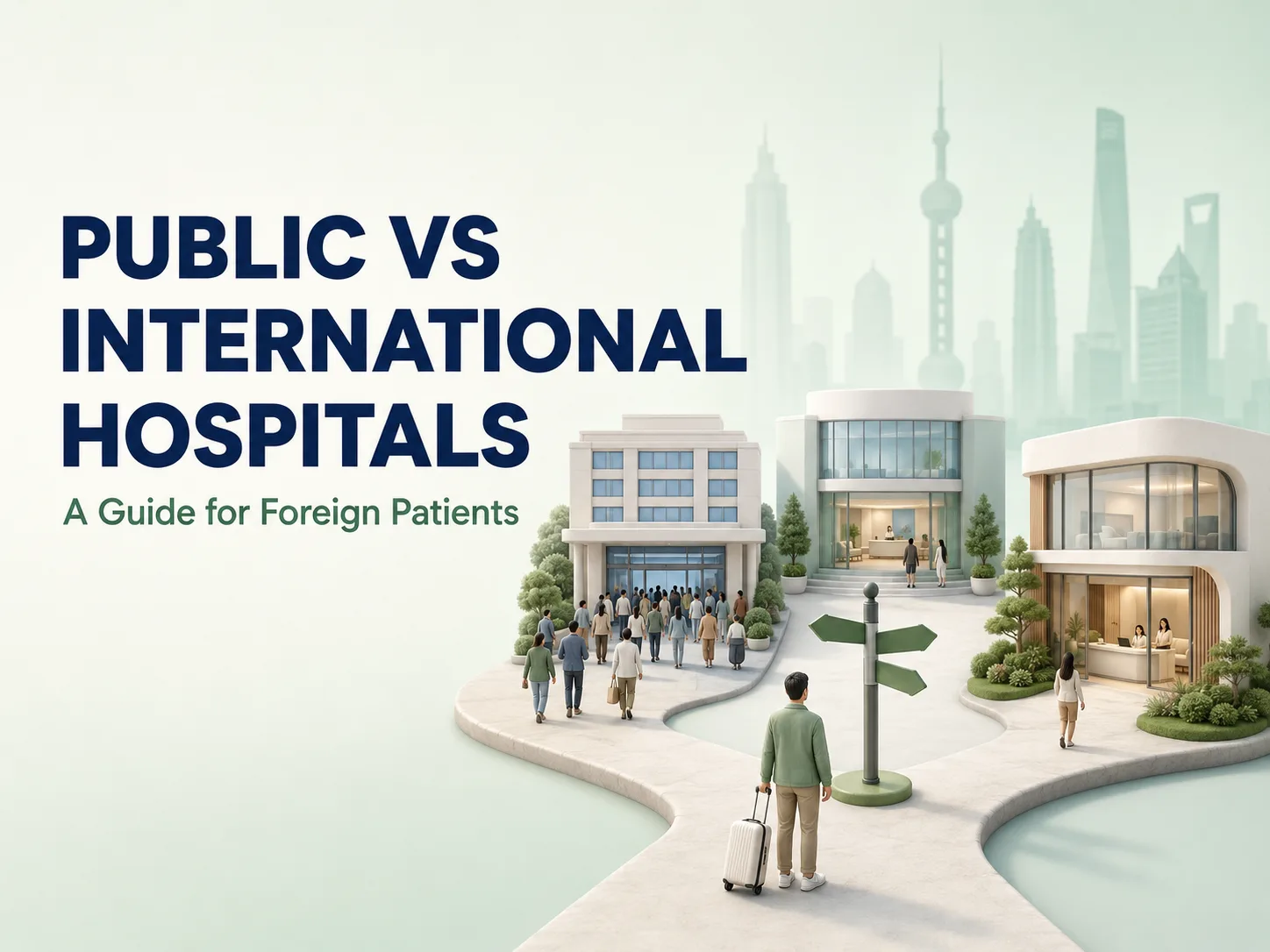
If you’re still deciding between public and international medical services, read our guide to public and international hospitals in China before making a shortlist.
Choose the Specialty Before Choosing the City
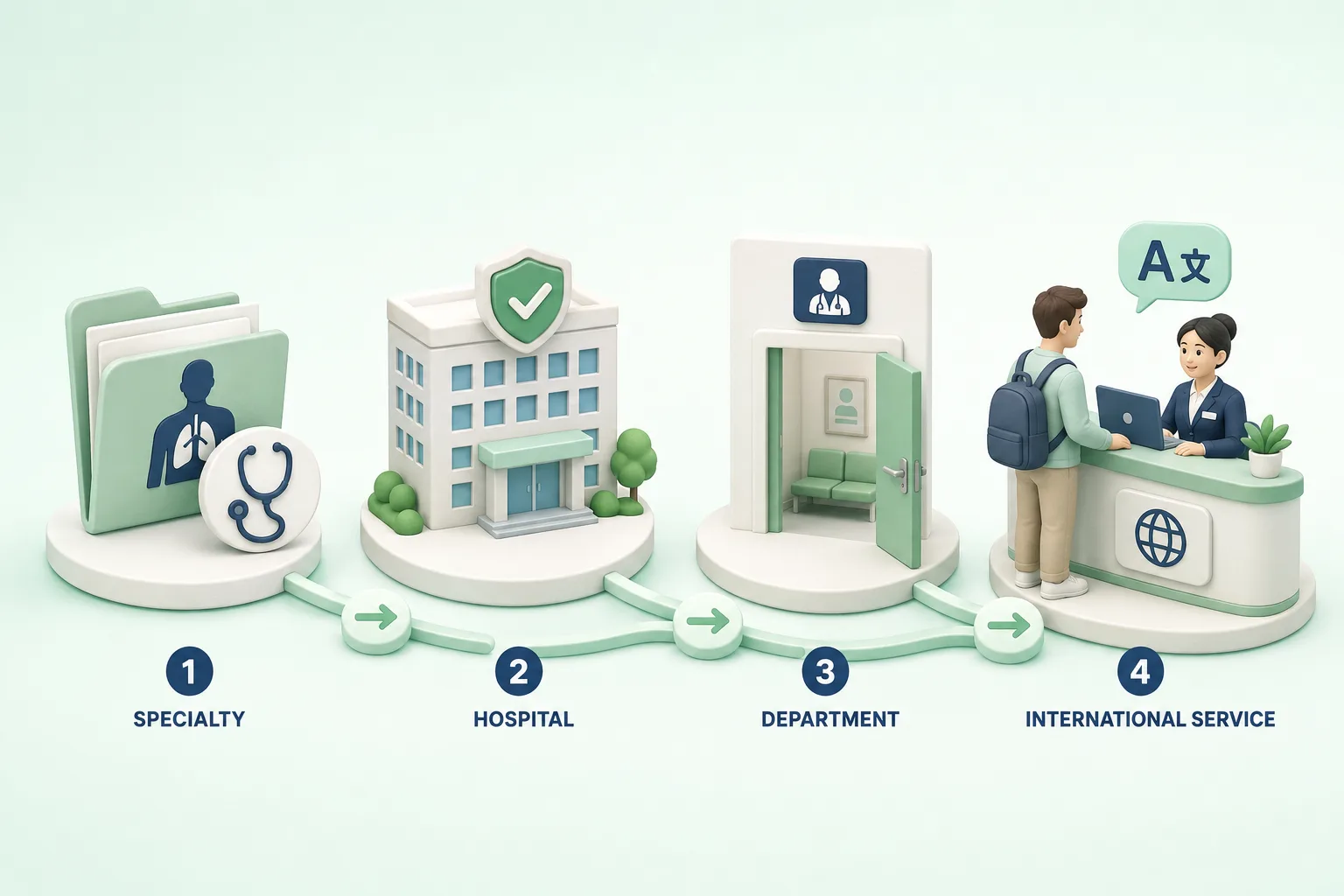
A large general hospital may be excellent overall but not necessarily the strongest choice for your particular condition.
Start by identifying the relevant specialty:
| Medical need | Department names you may see |
|---|---|
| Heart condition | Cardiology / Cardiovascular Surgery |
| Joint or bone problem | Orthopedics |
| Brain or nerve condition | Neurology / Neurosurgery |
| Digestive condition | Gastroenterology / Gastrointestinal Surgery |
| Cancer treatment | Oncology / Surgical Oncology / Radiotherapy |
| Kidney condition | Nephrology / Urology |
| Blood disorder | Hematology |
| Rehabilitation | Rehabilitation Medicine |
| Traditional Chinese medicine | TCM / Traditional Chinese Medicine |
The correct department can depend on your diagnosis and proposed treatment. For example, a patient with a spinal condition may need orthopedics, spinal surgery, neurosurgery or rehabilitation medicine.
If you’re unsure, ask the hospital to review a short medical summary and recommend the appropriate department. Don’t book a random specialist simply because the doctor’s profile includes a familiar word.
Does a Grade-A Tertiary Hospital Mean It’s the Right Choice?
You’ll often see Chinese hospitals described as:
- 三级甲等医院
- 三甲医院
- Grade-A tertiary hospital
- Class A tertiary hospital
This generally indicates a high-level hospital with broad clinical services, specialist departments and significant medical capacity.
However, the designation doesn’t tell you everything you need to know about one particular department, procedure or international patient service.
A famous tertiary hospital may still be difficult for you if:
- the relevant specialist works at another campus;
- the department doesn’t offer international patient coordination;
- the booking platform can’t register a passport;
- interpretation isn’t available;
- the required medicine or procedure isn’t provided;
- inpatient admission has a long waiting period.
Use the hospital level as one screening factor—not as the final decision.
China’s National Health Commission provides official healthcare data and medical-institution registration searches. Municipal government websites may also publish hospital directories, contact information and specialty descriptions. These are more reliable starting points than an unverified social-media list.
Verify the Hospital Through Official Channels
Before sending medical documents or paying anyone, confirm that you’re dealing with the actual hospital.
Check:
- The hospital’s official name in Chinese and English.
- Its official website domain.
- The exact campus where the department is located.
- The international department’s official telephone number or email.
- Whether the hospital appears in a government or health-authority directory.
- Whether the person contacting you uses an official hospital channel.
Be careful with agents who promise a guaranteed appointment, guaranteed admission or guaranteed treatment result.
A legitimate coordinator may help with translation, transport and appointments, but the medical decision should still come from the hospital’s clinical team.
Never transfer a large treatment deposit to an individual’s personal account without written confirmation from the hospital.
Compare the Three Main Treatment Routes
Foreign patients generally encounter three types of service.
Public General Outpatient Department
This may be suitable when your priority is accessing a particular specialist or department at a lower service cost.
The medical care may be excellent, but the process is usually designed for local patients. Registration, payment, test booking and navigation may require Chinese.
Choose this route only after confirming:
- passport registration is possible;
- you know the correct department and campus;
- someone can help you communicate if needed;
- the hospital accepts your intended payment method;
- you understand how follow-up visits will work.
International or VIP Department Inside a Public Hospital
This route can provide access to specialists from a major public hospital with more support for international patients.
Depending on the hospital, the department may offer:
- bilingual coordination;
- longer consultation times;
- appointment assistance;
- help arranging tests or admission;
- English medical documents;
- commercial insurance coordination.
These services and fees vary substantially. Don’t assume every tertiary hospital has an international department or that every specialist sees patients through it.
Private International Hospital or Clinic
A private international facility may be easier if you need English communication, coordinated appointments or insurance assistance.
However, confirm that it can provide the actual treatment you need. Some international clinics are strong in outpatient and primary care but may refer complex surgery or intensive care to another hospital.
Ask what happens if you need:
- emergency treatment;
- intensive care;
- blood products;
- complex imaging;
- specialist surgery;
- an overnight hospital stay;
- transfer to another facility.
Convenient communication is valuable, but it shouldn’t replace checking clinical capability.
Confirm the Exact Department, Doctor and Campus
Large Chinese hospitals may operate several campuses. The doctor you found online may only work at one of them on certain days.
Before making travel plans, ask:
- Which department should assess my condition?
- Which campus provides this treatment?
- Does the named doctor currently see international patients?
- Will I see that doctor or another member of the medical team?
- Is the appointment for a consultation only?
- Can the hospital provide the proposed procedure?
- Would additional tests be required before treatment is accepted?
- Is inpatient admission available if recommended?
- How are follow-up appointments arranged?
A consultation appointment isn’t the same as confirmation of surgery, admission or a treatment plan.
The hospital may need to examine you and review new test results before deciding whether you’re suitable for treatment.
Check Whether Your Treatment Requires Special Authorization
For routine outpatient care, the department and doctor may be the main considerations.
For highly specialized treatment, confirm that the institution is authorized and equipped to provide the specific service. This can be relevant to areas such as organ transplantation, assisted reproductive technology, certain radiation treatments and other regulated procedures.
Don’t rely on a general claim that the hospital “treats the condition.” Ask whether it provides the exact procedure being considered.
Useful questions include:
- How many stages does the assessment involve?
- Is the treatment performed at this campus?
- Which specialist team reviews international cases?
- Are there eligibility requirements?
- Are specific tests required before the hospital will accept the case?
- Does the hospital need pathology slides, imaging files or laboratory samples?
The answers should come from the hospital, not only from a travel coordinator.
Confirm Language Support Before Booking
English support varies by city, hospital, department and shift.
Shanghai’s official international services guide notes that many public hospitals have VIP or international departments with bilingual staff. That doesn’t mean every doctor or general outpatient desk across China can communicate comfortably in English.
Ask specifically:
- Is an English-speaking coordinator available?
- Is interpretation included or charged separately?
- Can I bring my own interpreter?
- Can the hospital issue an English medical summary?
- Will prescriptions and discharge instructions be available in English?
- Who should I contact if I have questions after discharge?
If interpretation isn’t available, arrange a professional medical interpreter. A translation app can help with directions and basic registration, but it isn’t a safe substitute for interpreting complex consent forms, risks or treatment instructions.
Review the Full Patient Journey
Don’t choose a hospital based only on the first consultation.
Think about the entire route:
- Pre-arrival medical record review
- First appointment
- Diagnostic tests
- Treatment decision
- Deposit or payment
- Hospital admission
- Treatment or procedure
- Discharge
- Recovery accommodation
- Follow-up
- Medical clearance for travel
- Records and medication before returning home
If the hospital can provide treatment but has no practical route for follow-up or international communication, you may need a second provider for recovery care.
Your medical trip should be planned around treatment and recovery. Tourism comes later, and only if your treating doctor says you’re ready.
Ask About Costs Without Expecting a Guaranteed Quote
Before choosing a hospital, request information about:
- consultation fees;
- interpreter or international service fees;
- likely tests;
- estimated treatment range;
- admission deposit;
- accepted payment methods;
- commercial insurance arrangements;
- cancellation and refund rules.
A pre-arrival estimate isn’t a final bill. Costs may change after examination, testing or complications.
If you plan to use international insurance, ask both the hospital and insurer whether direct billing is available for your policy. Beijing’s official medical guide explains that direct billing depends on an existing arrangement between the medical institution and insurance company.
Otherwise, you may need to pay first and submit the invoice, itemized bill and medical documents for reimbursement.
Use This Hospital Selection Checklist
Before placing a hospital on your final shortlist, confirm:
-
The hospital’s identity through an official source
-
The exact department that handles your condition
-
The correct hospital campus
-
Whether international patients are accepted
-
Whether passport registration is supported
-
Language or interpreter arrangements
-
Whether the required treatment is actually available
-
How medical records should be submitted
-
Consultation and estimated treatment costs
-
Deposit and payment rules
-
Insurance or reimbursement documentation
-
Inpatient and follow-up arrangements
-
Recovery accommodation close to the hospital
-
A backup hospital if the case isn’t accepted
If several items remain unclear, don’t book a non-refundable flight yet.
Chinese Message to Ask for the Correct Department
我是外国患者,计划来中国接受治疗。请问贵院哪个科室可以评估我的病情?是否有国际医疗服务?
Wǒ shì wàiguó huànzhě, jìhuà lái Zhōngguó jiēshòu zhìliáo. Qǐngwèn guìyuàn nǎge kēshì kěyǐ pínggū wǒ de bìngqíng? Shìfǒu yǒu guójì yīliáo fúwù?
I’m an international patient planning to receive treatment in China. Which department can assess my condition? Do you provide international medical services?
Add the Chinese name of your diagnosis if you have a reliable translation.
Warning Signs to Avoid
Pause before paying or sharing sensitive documents if:
- the provider won’t identify the hospital or department;
- all communication happens through a personal social-media account;
- you’re promised a guaranteed cure;
- the agent won’t let you speak with the hospital;
- you’re asked to transfer money to an unrelated personal account;
- the proposed hospital campus can’t be verified;
- the treatment description is vague;
- no one explains follow-up or complications;
- the price sounds fixed before any clinical assessment.
Good coordination should make the hospital process clearer, not hide it.
FAQ
What is the best hospital in China for foreigners?
Choose according to the relevant specialty, clinical capability, international patient access, language support, cost structure and follow-up arrangements.
Should I only choose a Grade-A tertiary hospital?
A Grade-A tertiary hospital can be a useful starting point for complex treatment, but the relevant department and medical team matter more than the label alone.
Can foreigners receive treatment at Chinese public hospitals?
Does every public hospital have an international department?
Some major public hospitals have international or VIP medical departments, while others only provide general outpatient services.
Can a hospital confirm my surgery before I arrive?
Some hospitals can review records before arrival, but a final treatment decision may require an in-person consultation, new tests or multidisciplinary assessment.
Should I choose the hospital before booking flights?
Confirm at least the correct department, international patient route and consultation availability before purchasing non-refundable travel arrangements.