Do You Need a Power Adapter for China? Plugs, Voltage & Travel Guide
You arrive at your hotel in China, take out your phone charger, and look at the wall socket. The holes don’t quite look like the ones at home. Your battery is almost empty, but you’re not sure whether plugging in your charger is safe.
What you need depends on two separate things:
- Does your plug physically fit the socket?
- Can your device safely handle China’s 220V electricity?
For most phones, tablets, cameras, and laptops, you’ll only need a simple travel plug adapter—sometimes not even that. However, appliances designed only for 110V, especially hair dryers and styling tools, may require a voltage converter or should be left at home.
This guide covers mainland China. Hong Kong and Macao use different socket arrangements, so check them separately if they’re part of your trip.
What Plugs and Voltage Are Used in China?
Mainland China uses:
| Item | Standard in mainland China |
|---|---|
| Voltage | 220V |
| Frequency | 50Hz |
| Common plug types | Type A, Type C and Type I |
China’s 220V, 50Hz supply is confirmed in official Chinese travel information, while Electrical Safety First identifies Type A, Type C and Type I as the plug types commonly associated with China. China National Space Administration travel information, Electrical Safety First
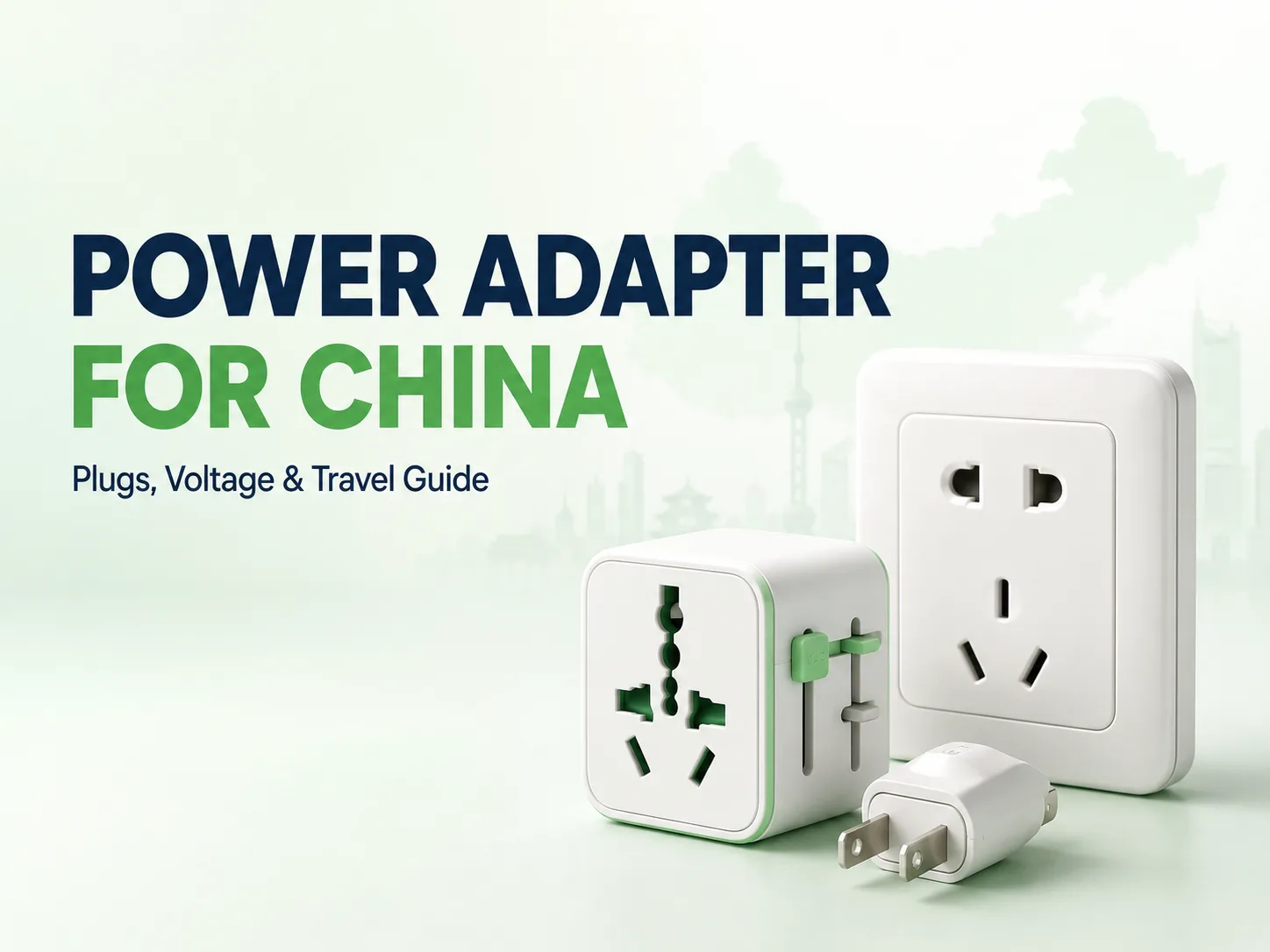
You’ll commonly see wall panels with two sections:
- A two-pin socket at the top
- A three-pin angled socket at the bottom
Many hotels also install universal sockets that accept several international plug shapes. They’re useful, but don’t assume every hotel, café, train, or older building will have them.
What Do Chinese Power Outlets Look Like?
Type A: Two flat parallel pins
This is the familiar two-pin plug used in the United States, Canada, Japan, and several other countries.
An ungrounded two-pin US or Japanese charger will often fit a Chinese socket. However, there are two common problems:
- A polarized plug with one blade wider than the other may not fit.
- A three-pin Type B plug with a round grounding pin usually needs an adapter.
Even if your US plug fits, remember that the socket still supplies 220V. The shape fitting does not mean the voltage is safe for every device.
Type C: Two round pins
Type C is the slim two-round-pin Europlug used across much of continental Europe.
Small Type C phone and laptop chargers can often be connected directly to compatible sockets in China. Larger grounded European Type E or Type F plugs may not fit properly, so European travelers should still carry an adapter.
Type I: Angled flat pins
Type I has two flat pins arranged at an angle, with some versions adding a third grounding pin.
This shape is familiar to travelers from Australia and New Zealand. It is also used in China, although the socket may appear in a different orientation on the wall. Australian and New Zealand plugs will often fit, but a compact adapter is still useful when you encounter a different socket panel.
💡 Not sure about your specific device?
Skip reading the manual and test your tech in seconds with our free China Plug & Voltage Checker Tool. Just pick your country and device to see if it's safe to plug in!
Power Adapter and Voltage Converter Are Not the Same Thing
This is the part that causes the most confusion.
A travel plug adapter changes the physical plug shape. It allows your plug to fit into the wall socket, but it does not change the voltage.
A voltage converter changes the electrical voltage—for example, from China’s 220V supply to approximately 110V for a device designed only for North American or Japanese power.
So, if you connect a 110V-only hair dryer to a simple plug adapter, the device is still receiving 220V. It may overheat, fail immediately, trip the circuit breaker, or create a fire risk.
How to Check Whether Your Device Works in China
Before packing, look at the small label printed on your charger, power brick, or appliance.
You’re looking for a line beginning with Input.
If the label says “100–240V, 50/60Hz”
You can use the device in China without a voltage converter.
You may only need a plug adapter so that it fits the socket.
This is common on:
- Smartphone chargers
- Laptop chargers
- Tablet chargers
- Camera battery chargers
- USB-C chargers
- Portable game console chargers
- Many electric toothbrush chargers
For example, Apple lists its 20W USB-C power adapter as compatible with 100–240V and 50–60Hz, so it can handle mainland China’s electrical supply. Apple iPhone power adapter specifications
Still, check the label on your own charger rather than assuming every product has the same specification.
If the label says “220–240V, 50Hz”
The device is normally suitable for mainland China. You may need only a plug adapter.
This is common for appliances purchased in the UK, Europe, Australia, New Zealand, and other places that use approximately 220–240V electricity.
If the label says only “110V,” “120V,” or “100–120V”
Do not connect it directly to a Chinese wall socket.
You would need a suitable step-down voltage converter. The converter must also support the appliance’s wattage, which becomes particularly important with hair dryers, curling irons, straighteners, kettles, and other heating appliances.
In many cases, leaving a 110V-only high-power appliance at home is easier and safer than carrying a large converter.
If you can’t find the voltage information
Check:
- The charger or power brick
- The bottom or back of the device
- The original manual
- The manufacturer’s official website
Don’t rely only on the product name. Two models of the same appliance may have different voltage ratings in different markets.
Do Travelers from the US or Canada Need an Adapter for China?
It’s a good idea to bring one.
Many two-flat-pin Type A phone chargers will fit Chinese sockets. However:
- Three-pin Type B plugs usually need an adapter.
- Polarized plugs with one wide blade may not fit.
- Some hotel sockets hold foreign plugs loosely.
- Not every socket panel accepts Type A plugs.
The more important issue is voltage. The US and Canada generally use about 120V, while mainland China uses 220V.
Your phone and laptop chargers probably support 100–240V, but check the label. Hair dryers, electric shavers, curling irons, small fans, and other appliances may be 120V only.
Do Travelers from the UK Need an Adapter?
Yes. UK Type G plugs have three large rectangular pins and normally do not fit mainland Chinese sockets.
Most UK devices are already designed for 220–240V, so you’ll usually need a plug adapter rather than a voltage converter.
Choose an adapter that accepts a UK Type G plug and connects safely to a Chinese Type I socket.
Do Travelers from Europe Need an Adapter?
It depends on the plug.
A slim two-pin Type C Europlug will often fit. Grounded Type E and Type F plugs are larger and may not fit Chinese sockets properly.
Because socket designs vary between hotels and buildings, carrying a China-compatible travel adapter is still the safer option.
Voltage is less of a problem for most European devices because they commonly operate at 220–240V and 50Hz. Check the label anyway, particularly for appliances bought outside Europe.
Do Travelers from Australia or New Zealand Need an Adapter?
Australian and New Zealand Type I plugs are similar to the Type I system used in China, so many will fit without an adapter.
However, Chinese socket orientation and construction can be different. A small universal travel adapter can help if the plug feels loose or if the available socket is designed for another plug type.
Since Australia and New Zealand use similar voltage and frequency standards, a voltage converter usually isn’t required.
Do You Need a Converter for a Phone or Laptop?
Usually, no.
Most modern phone, tablet, camera, and laptop chargers are designed for international voltage. If the charger says:
Input: 100–240V, 50/60Hz
you can safely use it with China’s 220V, 50Hz electricity. You only need to solve the plug-shape problem.
A good setup is one reliable travel adapter plus a multi-port USB-C charger. That lets you charge several low-power devices without carrying a separate wall adapter for each one.
Make sure both the charger and travel adapter are safety-certified and rated for at least 220–240V.
What About Hair Dryers, Straighteners and Curling Irons?
Check these carefully. Heating appliances use much more power than phone chargers and are more likely to be single-voltage.
If your hair dryer says only 120V, a basic travel adapter is not enough.
Although high-wattage voltage converters exist, they can be heavy, expensive, and unsuitable for some electronically controlled styling tools. A small converter designed for charging electronics may not support a 1,500W hair dryer.
The easiest options are usually:
- Use the hair dryer supplied by your hotel.
- Bring a dual-voltage travel hair dryer.
- Buy or borrow a 220V appliance in China.
- Confirm compatibility with the manufacturer before traveling.
If a device has a manual voltage selector marked 110/220V, switch it to the correct setting before plugging it in.
What About CPAP Machines and Medical Equipment?
Don’t guess with medical equipment.
Many modern CPAP power supplies accept 100–240V, but you must check the exact model and power supply. The same applies to mobility equipment, nebulizers, breast pumps, and medical battery chargers.
The US Department of State advises travelers using accessibility or medical equipment to check both the destination voltage and the equipment requirements before traveling. US Department of State accessibility travel guidance
For essential equipment:
- Confirm the input voltage with the manufacturer.
- Bring the correct grounded adapter.
- Pack the power supply in your carry-on bag.
- Bring a power bank or battery backup if the device supports one.
- Don’t depend entirely on a hotel’s universal socket.
Be Careful with Cheap Universal Adapters
A travel adapter may look simple, but it still connects your device to 220V electricity.
Check that it:
- Clearly states a voltage rating of at least 250V
- Supports the wattage of your device
- Holds the plug firmly
- Has grounded connections if your device requires grounding
- Comes from a reputable manufacturer
- Includes a suitable fuse or safety protection where applicable
Avoid forcing a plug into a socket. If it feels loose, sparks, becomes unusually hot, or makes a buzzing sound, unplug it and use a different outlet or adapter.
Also remember that a travel adapter is not automatically a voltage converter. If the packaging says “This adapter does not convert voltage,” take that warning literally.
Can You Buy a Power Adapter After Arriving in China?
Yes. Travel adapters and USB chargers are widely available in China through convenience stores, electronics shops, supermarkets, hotel reception desks, and shopping apps.
If you need help in a store, you can show this:
请问有旅行转换插头吗?
Do you have a travel plug adapter?
For a voltage converter, show:
请问有220伏转110伏的变压器吗?
Do you have a 220V-to-110V voltage converter?
A converter is more specialized than a plug adapter, so don’t expect every convenience store or hotel to have one.
What Should You Pack?
For most travelers, this is enough:
- One reliable universal travel adapter
- One 100–240V multi-port USB or USB-C charger
- Your normal charging cables
- A power bank for travel days
- A compact extension lead only if it’s rated for 220–240V
If you’re traveling with a high-power or medical appliance, check its voltage before leaving home. Don’t wait until you’re standing in your hotel room with an incompatible plug.
FAQ
Can I charge my iPhone in China?
Can I use a US phone charger in China?
Is China 110V or 220V?
Will a European plug work in China?
Can I use an Australian plug in China?
Does a universal travel adapter convert voltage?
Do Chinese hotels have USB charging ports?
More to read
How to Use Public Transport in China: Metro, Buses & QR Codes for Tourists (2026)
2026.08.31
QR Code Payment in China: How to Scan and Pay as a Foreigner (2026)
2026.08.31