Best Translation Apps for China & Essential Chinese Phrases for Travelers (2026)
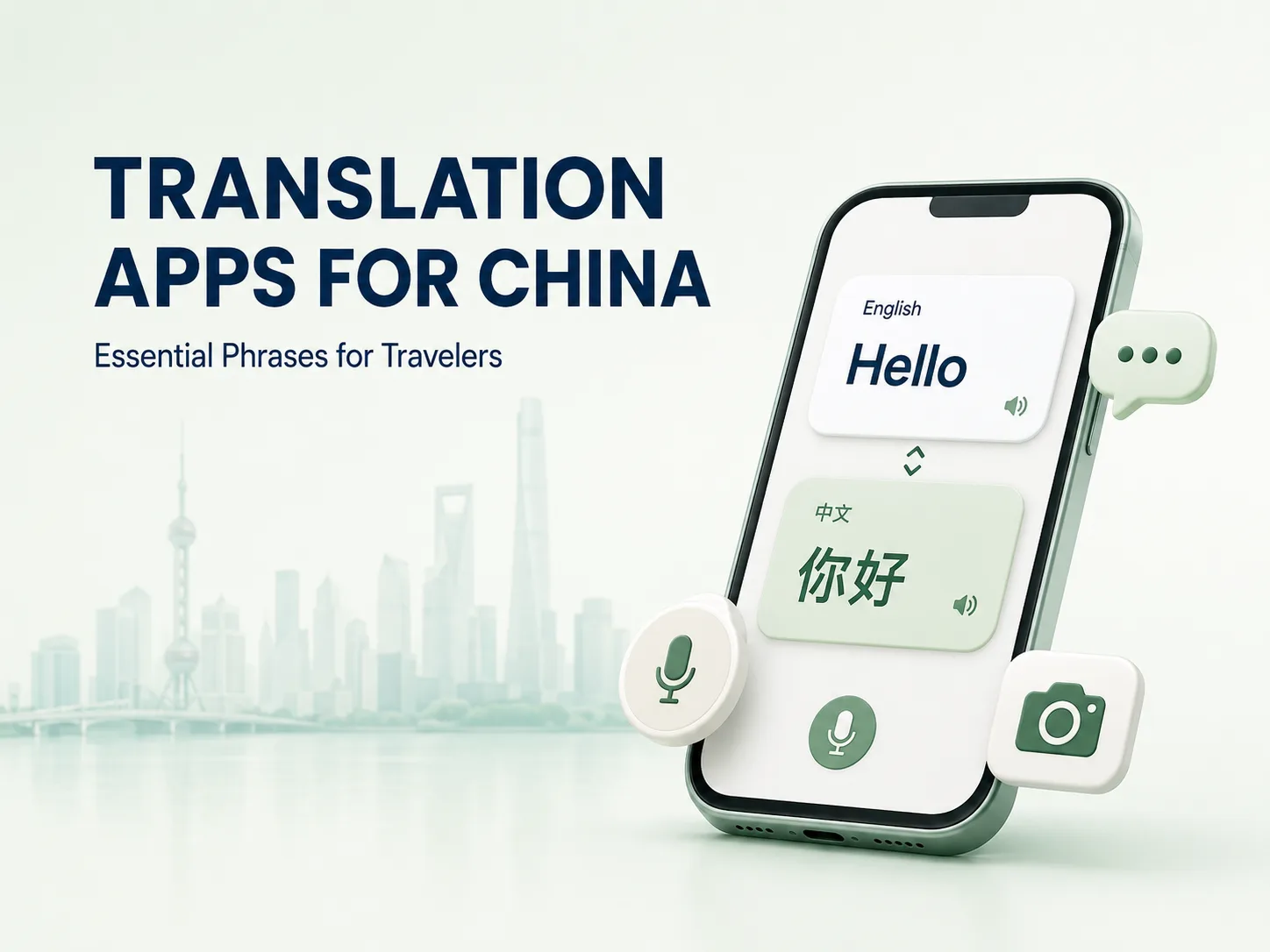
You’ve just arrived in China and got into a taxi. The driver asks where you’re going, but the hotel name on your booking is only in English. You open a translation app, and it either needs an internet connection or gives you a Chinese sentence that’s far too long to explain quickly.
This is exactly when language preparation matters.
You don’t need to speak fluent Mandarin to travel around China. In most situations, a translation app, a saved Chinese address, and a few well-prepared Chinese phrase cards will get you through. The key is setting everything up before you arrive, while you still have reliable Wi-Fi.
This guide compares the best translation apps for China, including Baidu Translate and Google Translate, and gives you practical Chinese phrases you can show to taxi drivers, restaurant staff, hotel receptionists, and medical workers.
Set Up Your Translation Tools Before Traveling to China
Don’t wait until you’re standing outside the airport to download a translation app.
Before leaving home, prepare at least two translation options: one main app and one backup. You should also download Simplified Chinese and your own language for offline use whenever the app supports it.
Complete these steps before your flight:
- Install your main translation app.
- Install a second app as a backup.
- Download Simplified Chinese for offline translation.
- Allow camera and microphone access if you plan to use photo or voice translation.
- Save your hotel’s Chinese name and full Chinese address.
- Screenshot the emergency phrase cards in this guide.
- Save your passport number, travel insurance details, allergies, and medication names somewhere you can access offline.
Test the apps in airplane mode before you travel. Type a short sentence, try the microphone, and point the camera at some Chinese text. This tells you which functions will still work without mobile data.
One local detail is especially important: Chinese taxi drivers and other service staff usually understand a written Chinese address more easily than an English place name or your attempt to pronounce the pinyin.
If you’re going to a hotel, hospital, attraction, or railway station, save its official Chinese name. Don’t rely on automatically translating the English name, because the result may not match the name local people actually use.
Baidu Translate vs Google Translate: Which Is Better in China?
Baidu Translate and Google Translate can both be useful, but they solve different problems in China.
| App | Best use in China | Advantages | What to prepare for |
|---|---|---|---|
| Baidu Translate | Online translation on a mainland Chinese network | Works within China’s local internet environment and offers text, camera, image, and voice translation | Parts of the interface may be difficult to navigate if you cannot read Chinese |
| Google Translate | Offline translation and a familiar international interface | Supports downloaded languages, camera translation, saved phrases, voice input, and conversation mode | Google’s online services should not be your only translation option in mainland China |
| Apple Translate | A backup for iPhone users | Supports text, voice, conversations, camera translation, and downloaded languages | Available languages and features depend on your device and operating system |
| Pleco | Looking up individual Chinese words and characters | Useful for meanings, pronunciation, pinyin, and reading unfamiliar Chinese characters | Better as a dictionary than as your main conversation translator |
When Baidu Translate Is the Better Choice
Baidu Translate is usually the more practical online option when your phone is connected to a mainland Chinese SIM card, hotel Wi-Fi, or local public Wi-Fi.
Its official service includes text, photo, image, AR camera, and voice translation. This makes it useful when you need to photograph a Chinese menu, read a notice, or let someone speak into your phone.
The main difficulty for foreign travelers is not the translation technology. It’s the interface. Some screens, account prompts, or extra learning features may appear in Chinese, so install and test the app before your trip. Don’t make your first attempt while a taxi driver or restaurant employee is waiting for you.
When Google Translate Is Still Useful
Google Translate is familiar to many international travelers and supports offline language downloads. If you download Simplified Chinese before entering China, you can continue using supported offline functions without depending on a local internet connection.
However, Google services are restricted on ordinary mainland Chinese networks. Online access may be unavailable or inconsistent, so Google Translate should be treated as an offline tool or backup rather than your only translation app.
If you plan to use it:
- Install the app before traveling.
- Download your own language and Simplified Chinese.
- Save your most important phrases to the phrasebook.
- Test the app with mobile data turned off.
Camera, conversation, and other functions may behave differently online and offline. Always test the exact features you intend to use.
A Practical Recommendation
For most foreign travelers, this is the safest setup:
- Use Baidu Translate when you have a working connection in China.
- Keep Google Translate with downloaded Chinese as an offline backup.
- If you use an iPhone, download Chinese in Apple Translate as a second offline option.
- Save important Chinese text as screenshots instead of relying entirely on an app.
A screenshot cannot lose its connection, ask you to sign in, or fail to load at the wrong moment.
Using Translation Apps in a Taxi
A taxi driver usually needs two pieces of information:
- The destination’s Chinese name
- The complete Chinese address
Showing only an English hotel name may not be enough. International hotel brands can have several properties in the same city, and their local Chinese names may sound completely different from their English names.
For example, don’t simply show “Marriott Shanghai.” Find the exact branch, its Chinese name, district, road, and street number.
Hold your phone horizontally if possible, enlarge the Chinese text, and let the driver read it. There’s usually no need to read the pinyin aloud.
Chinese Taxi Card
Please take me to this address.
请带我去这个地址,谢谢。
Qǐng dài wǒ qù zhège dìzhǐ, xièxie.
Destination name:
目的地名称:
Address:
地址:
Please follow the navigation.
请按导航走。
Qǐng àn dǎoháng zǒu.
Please stop here.
请在这里停车。
Qǐng zài zhèlǐ tíngchē.
Is this the correct place?
是这里吗?
Shì zhèlǐ ma?
When using DiDi, the destination is normally selected inside the app, but it’s still worth keeping the Chinese address. Airport and railway station pick-up areas can be confusing, and a driver may call or message you to confirm your location.
Using Translation Apps in a Restaurant
Camera translation works well for understanding the general meaning of a menu, but don’t assume every dish name will be translated literally.
Chinese menu names sometimes describe a cooking method, regional style, or creative dish name rather than listing every ingredient. A translated name may help you understand the dish, but it may not reveal whether it contains pork, peanuts, shellfish, sesame oil, or another ingredient.
If you have a food allergy, show the staff a separate Chinese message. Don’t hide the allergy inside a long translated paragraph.
There is also an important difference between these two statements:
- “I don’t like peanuts.”
- “I have a serious peanut allergy.”
A machine translation or hurried conversation can easily make the first sound like a personal preference. If the allergy is serious, say so clearly.
Chinese Restaurant Card
Is this dish spicy?
这个菜辣吗?
Zhège cài là ma?
Please make it less spicy.
请少放一点辣。
Qǐng shǎo fàng yìdiǎn là.
I do not eat pork.
我不吃猪肉。
Wǒ bù chī zhūròu.
I am vegetarian. I do not eat meat or seafood.
我吃素,不吃肉,也不吃海鲜。
Wǒ chī sù, bù chī ròu, yě bù chī hǎixiān.
I have a serious allergy to the food written below. Please do not add it.
我对下面写的食物严重过敏,请不要放。
Wǒ duì xiàmiàn xiě de shíwù yánzhòng guòmǐn, qǐng búyào fàng.
Allergy:
过敏食物:
Does this contain peanuts or other nuts?
这个里面有花生或其他坚果吗?
Zhège lǐmiàn yǒu huāshēng huò qítā jiānguǒ ma?
For a severe allergy, machine translation should only support the conversation. Ask the staff to confirm with the kitchen, and carry your medication with you.
Using Translation Apps at a Hotel
Most international hotels in large Chinese cities have English-speaking staff, but smaller hotels and properties outside major tourist areas may not.
At check-in, show your passport and booking confirmation first. If the receptionist cannot find the reservation, show the booking name, confirmation number, booking platform, and room dates separately.
Long translated explanations usually make the situation harder. Give the receptionist one piece of information at a time.
Chinese Hotel Card
I have a reservation at this hotel.
我在这家酒店有预订。
Wǒ zài zhè jiā jiǔdiàn yǒu yùdìng.
This is my booking confirmation.
这是我的预订确认单。
Zhè shì wǒ de yùdìng quèrèn dān.
The reservation is under this name.
预订人姓名是:
Yùdìng rén xìngmíng shì:
What is the Wi-Fi password?
请问Wi-Fi密码是什么?
Qǐngwèn Wi-Fi mìmǎ shì shénme?
Could you help me call a taxi?
可以帮我叫一辆出租车吗?
Kěyǐ bāng wǒ jiào yí liàng chūzūchē ma?
Please write the hotel’s name and address in Chinese for me.
请帮我写一下酒店的中文名称和地址。
Qǐng bāng wǒ xiě yíxià jiǔdiàn de Zhōngwén míngchēng hé dìzhǐ.
That last sentence is particularly useful. Ask the hotel to give you a printed card or save the Chinese address on your phone before going out.
Using Translation Apps at a Hospital
Translation apps can help you register, describe a simple symptom, or ask where a department is located. They should not be treated as a substitute for a doctor, medical interpreter, or careful confirmation of medication instructions.
Before traveling, prepare an offline medical note containing:
- Your full name and date of birth
- Existing medical conditions
- Medication names and dosages
- Drug and food allergies
- Emergency contact information
- Travel insurance provider
- A photo of your prescriptions or medicine packaging
Keep medicine names in their original language and include the generic name if you know it. Brand names can differ between countries.
When speaking to medical staff, use short factual sentences. Avoid translating a long personal explanation all at once.
Chinese Medical Card
I need to see a doctor.
我需要看医生。
Wǒ xūyào kàn yīshēng.
I need an English-speaking doctor if possible.
如果可以,我需要一位会说英语的医生。
Rúguǒ kěyǐ, wǒ xūyào yí wèi huì shuō Yīngyǔ de yīshēng.
I am taking these medicines.
我正在服用这些药。
Wǒ zhèngzài fúyòng zhèxiē yào.
I am allergic to this medicine.
我对这种药过敏。
Wǒ duì zhè zhǒng yào guòmǐn.
I need an ambulance. Please call 120.
我需要救护车,请拨打120。
Wǒ xūyào jiùhùchē, qǐng bōdǎ yāo-èr-líng.
China’s nationwide emergency numbers include:
- 110: Police
- 119: Fire
- 120: Ambulance and medical emergencies
- 122: Traffic accidents
Calls to these emergency numbers are free. English assistance may not always be immediately available, so ask a hotel employee, station worker, police officer, or nearby Chinese speaker to help make the call if possible.
How to Get More Accurate Translations
Translation apps work better when you give them simple, direct language.
Instead of entering:
I was wondering if it might be possible for you to help me find the place where I’m supposed to meet my driver.
Use:
Where is the taxi pick-up area?
Keep each message focused on one question. If you ask about the price, opening time, payment method, and directions in the same sentence, the translated result becomes harder to check and harder for the other person to answer.
These habits usually produce clearer results:
- Use short sentences.
- Avoid slang, jokes, and idioms.
- Enter one request at a time.
- Use exact names, dates, times, and numbers.
- Translate the Chinese result back into English when the meaning is important.
- Let the other person read the Chinese instead of trying to pronounce a long sentence.
- Ask the other person to type or speak into the app.
- Double-check addresses, medicine doses, allergies, and travel times.
- Never rely on a machine translation alone for serious medical, legal, or safety decisions.
When translating a destination, copy its official Chinese name from the hotel, attraction, hospital, railway, or booking page. An automatically translated English name may produce a correct literal translation but still be different from the name used locally.
What to Do When You Have No Internet
If your connection stops working, switch to your downloaded offline language pack. If the app still cannot complete the translation, use your saved screenshots.
Your offline folder should include:
- Hotel name and address in Chinese
- Airport or railway station name in Chinese
- Passport information page
- Travel insurance information
- Emergency contact details
- Medication and allergy information
- Taxi, restaurant, hotel, and medical phrase cards
- Tickets and booking confirmations
- A simple map or screenshot showing your destination
Keep these files in a normal photo album or offline folder, not only inside your email or a cloud drive.
You can also create a separate photo album called “China Travel” so you don’t have to search through hundreds of pictures while someone is waiting.
Do You Need to Learn Chinese Before Visiting China?
You don’t need to learn Mandarin before a short trip, but a few words can make everyday interactions friendlier.
Useful basics include:
- Hello: 你好 — Nǐ hǎo
- Thank you: 谢谢 — Xièxie
- Excuse me / May I ask: 请问 — Qǐngwèn
- Yes / Correct: 对 — Duì
- No / Incorrect: 不对 — Bú duì
- How much is it?: 多少钱?— Duōshao qián?
- Where is it?: 在哪里?— Zài nǎlǐ?
- I don’t understand: 我听不懂 — Wǒ tīng bù dǒng
Don’t put pressure on yourself to pronounce a full Chinese address. Mandarin tones can change the meaning of a word, and a driver may find it easier to read the address directly from your screen.
A friendly “nǐ hǎo” and “xièxie” are useful. For anything involving directions, allergies, medicine, money, or bookings, written Chinese is safer.
Final Preparation Checklist
Before flying to China, check that you have:
- A translation app that works on a mainland Chinese network
- A second translation app with offline Chinese downloaded
- Your hotel’s official Chinese name and address
- Saved taxi, restaurant, hotel, and medical phrase cards
- Offline copies of bookings and tickets
- Your medication and allergy information
- China’s emergency phone numbers
- A working SIM, eSIM, or roaming plan
Translation technology helps, but the best backup is still simple written Chinese that you can open without a connection.
Prepare it before the flight, keep it easy to find, and show the Chinese text directly when you need help. In most everyday situations, that will work better than trying to explain everything aloud.
FAQ
Does Google Translate work in China?
Is Baidu Translate better than Google Translate in China?
Which type of Chinese should I download?
Can I use camera translation for Chinese menus?
Should I save pinyin or Chinese characters?
More to read
How to Use Public Transport in China: Metro, Buses & QR Codes for Tourists (2026)
2026.08.31
QR Code Payment in China: How to Scan and Pay as a Foreigner (2026)
2026.08.31