Essential Apps for China Travel: What Foreign Travelers Should Download
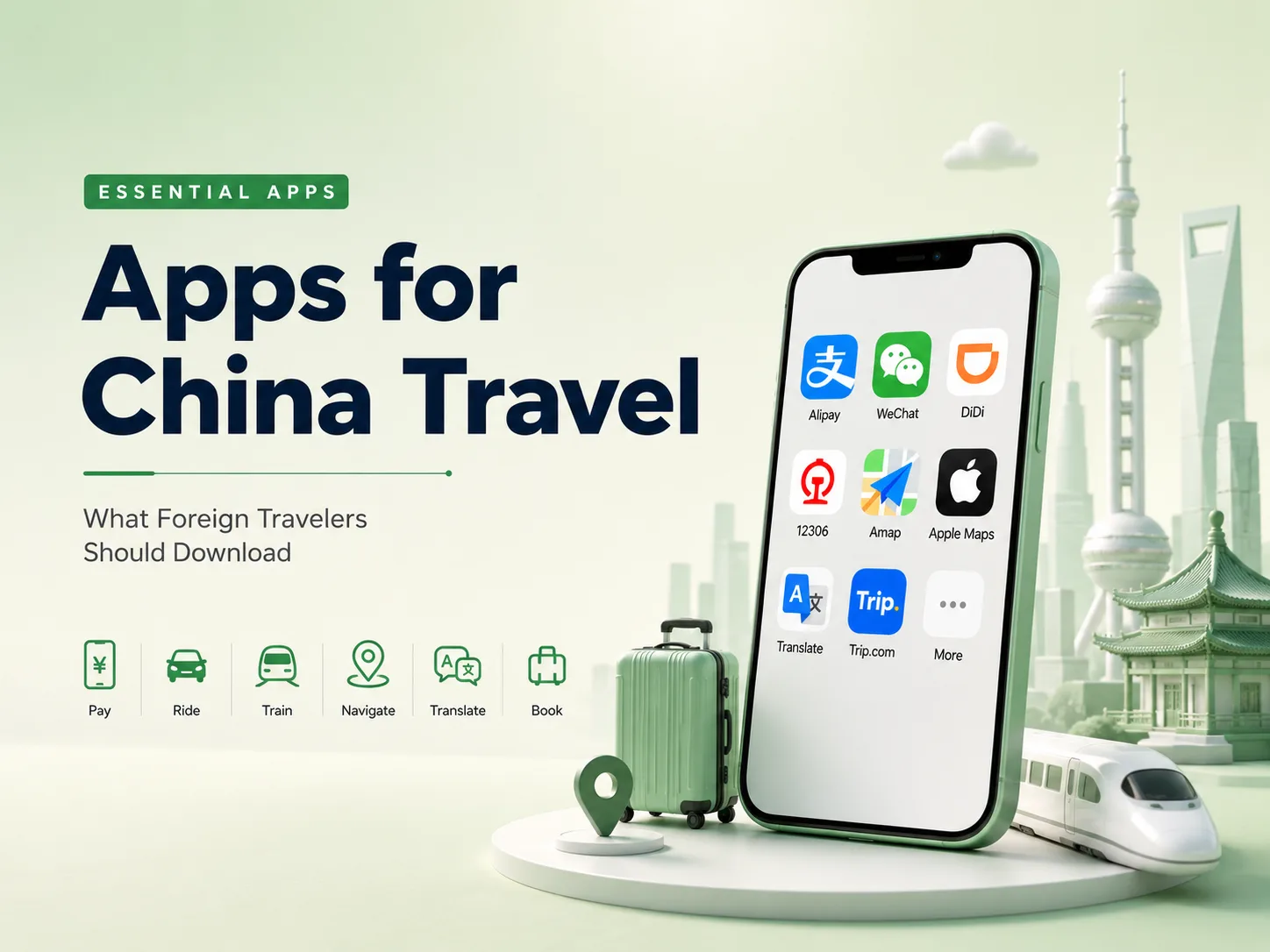
If you're traveling to China for the first time, your phone will probably become one of the most useful things you bring with you.
You'll use it to pay for meals, find your hotel, call a car, navigate the metro, book high-speed trains, translate Chinese, and stay in touch with people.
But here's the good news:
You don't need to download twenty different Chinese apps before your trip.
For most foreign travelers, a handful of apps will cover almost everything you need.
Here are the ones I'd get ready before coming to China.
1. Alipay — Payments and Everyday Services
If you're only going to set up a few apps before your trip, Alipay should be near the top of the list.
Mobile payments are part of everyday life in China. You'll see QR codes at restaurants, convenience stores, shopping malls, attractions and plenty of smaller local businesses.
Foreign travelers can use Alipay with eligible international bank cards.
But Alipay isn't just for payments.
Depending on the services available in your location, you can also use it for things such as:
- Paying at shops and restaurants
- Ride-hailing
- Public transportation
- Mini programs
- Some travel and local services
For everyday payments, you'll usually either scan the merchant's QR code or show your own payment code for the merchant to scan.
Before your trip: Download Alipay, register your account, complete any required verification and add a supported international bank card.
If you haven't done that yet, see our How to Pay in China: Alipay, WeChat Pay & Cash Guide for Foreigners.
2. WeChat — Messaging, Payments and Mini Programs
WeChat is much more than a messaging app in China.
You'll see it used for communication, payments, QR codes, mini programs, customer service and all kinds of everyday interactions.
As a traveler, you may use WeChat to:
- Message people in China
- Use Weixin Pay / WeChat Pay
- Scan QR codes
- Access mini programs
- Contact hotels or businesses
- Use certain local services
If you're visiting friends, meeting Chinese business contacts or spending more than a few days in China, it's especially useful.
Do You Need Both Alipay and WeChat?
Not necessarily.
If Alipay is working and you have another payment method as backup, you don't need to spend your first evening in China setting up every possible payment app.
But WeChat is useful for much more than payments, so I would still install it before traveling.
3. Amap — Maps and Navigation in China
Amap, also known as Gaode Maps (高德地图), is one of the most useful navigation apps for traveling around China.
It provides multilingual services for international visitors, including English, and can help with:
- Walking directions
- Public transportation
- Driving routes
- Metro stations
- Restaurants
- Hotels
- Attractions
- Shops and other nearby places
Amap is particularly useful because its local map and transportation information is built around everyday travel in China.
Keep Chinese Place Names Handy
Even when you're using an English interface, I still recommend saving important destinations in Chinese.
For example:
Shanghai Hongqiao Railway Station
上海虹桥站
Do the same with your hotel.
This makes it much easier to search for the correct place, book a DiDi or show the destination to someone if you need help.
4. DiDi — Ride-Hailing in China
If you've used Uber or Grab before, DiDi will feel familiar.
You enter your pickup location and destination, choose a ride option, and the app matches you with a driver.
For foreign travelers, one of the biggest advantages is simple:
You don't have to explain your entire destination in Chinese.
The driver can already see where you're going.
DiDi can be particularly useful for:
- Getting from your hotel to an attraction
- Going to a restaurant
- Traveling to a railway station
- Getting around late at night
- Short trips where public transportation isn't convenient
Foreign travelers can use DiDi with supported international phone numbers and payment methods. Ride-hailing services can also be accessed through platforms such as Alipay and WeChat.
If it's your first time using it, see our complete guide:
How to Use DiDi in China: A Guide for Foreign Travelers
One tip worth remembering:
At airports and large railway stations, find the designated ride-hailing pickup area before ordering your car.
Otherwise, you and your driver may spend ten minutes trying to find each other.
5. Railway 12306 — High-Speed Train Tickets
If you're planning to visit more than one city in China, you'll probably come across Railway 12306.
12306 is the official ticketing platform of China Railway.
Foreign travelers can use supported passport information to register and purchase train tickets.
You can use 12306 to:
- Search train schedules
- Check ticket availability
- Buy train tickets
- View bookings
- Change eligible tickets
- Request eligible refunds
If you're planning to take China's high-speed trains, I recommend setting up your 12306 account before you actually need to book an important ticket.
Passport identity verification may be required, and it's much easier to sort that out when you're not in a hurry.
For the full process, see our How to Take High-Speed Trains in China: A Guide for Foreign Travelers.
China Railway 12306 English Website
6. A Translation App — Keep One Ready
You don't need to speak Mandarin to travel around China's major cities.
But having a translation app on your phone can make certain situations much easier.
You'll probably use it more than you expect—for example:
- Reading a menu
- Understanding a sign
- Asking a question at a small shop
- Communicating with a driver
- Reading instructions
- Explaining something at a hotel
The exact translation app you use isn't as important as having one you're comfortable with.
Look for features such as:
Chinese ↔ English translation
Camera translation
Voice translation
Offline language support
Camera translation is especially useful.
Instead of trying to type Chinese characters you don't recognize, you can simply point your phone at the text.
If your preferred app offers offline Chinese language packs, downloading them before your trip is also a good idea.
7. Trip.com — Travel Bookings for International Visitors
For foreign travelers visiting China, Trip.com can be a useful all-in-one travel booking app.
You can use it for:
- Hotels
- Flights
- China high-speed train tickets
- Attractions and tickets
- Airport transfers
- Other travel services
One of its advantages is that Trip.com is designed for international travelers, with multilingual services and support for international users.
This can make the booking experience more familiar if it's your first trip to China.
Trip.com or 12306 for Train Tickets?
Both can be useful, but they're different.
12306 is the official China Railway ticketing platform.
Trip.com is a third-party travel booking platform aimed at international travelers.
If you're comfortable using 12306, booking directly through the official railway platform makes sense.
If you'd rather use a more familiar international travel interface, Trip.com can be another option.
8. Apple Maps — A Convenient Option for iPhone Users
If you're using an iPhone, Apple Maps can also be useful while traveling in China.
The biggest advantage is simple:
You already know how to use it.
That can be nice when you've just arrived and are already trying to figure out payments, transportation and everything else.
Depending on your device and location, Apple Maps can help with:
- Walking directions
- Public transportation
- Finding places
- Basic navigation
For more detailed local navigation, Amap is worth having as well.
You don't need to choose only one.
What About Metro and Public Transportation?
You don't necessarily need a separate metro app for every Chinese city you're visiting.
Transportation systems vary from city to city, and payment methods can differ too.
Depending on where you are, you may be able to use:
- Alipay
- Weixin Pay / WeChat Pay
- Local transportation QR codes
- Physical transportation cards
- Supported bank cards
- Local metro services
If you're visiting several cities, don't assume the subway works exactly the same way everywhere.
For most first-time visitors, Alipay + Amap is a very useful starting combination.
We'll cover public transportation in more detail in our separate Getting Around China guide.
What About Internet Access in China?
Some international websites and online services may work differently in China than they do in your home country.
That's something worth understanding before you arrive, especially if you rely on particular online services for work, communication or travel.
Rather than turning this app guide into a long discussion about internet access, we've covered that separately.
See our Internet & SIM Cards in China: A Guide for Foreign Travelers before your trip.
Which Apps Should You Download Before Flying to China?
You don't need every app mentioned above.
For a typical first trip, this is a good starting point:
| What you need | App |
|---|---|
| Payments | Alipay |
| Messaging & local services | |
| Maps & navigation | Amap |
| Ride-hailing | DiDi |
| High-speed trains | Railway 12306 |
| Translation | Your preferred translation app |
| Travel bookings | Trip.com |
| iPhone navigation backup | Apple Maps |
That already covers most situations you're likely to encounter.
If you later discover that you need another local app, you can always install it after you arrive.
Set Up the Important Apps Before You Leave
There's a difference between having an app installed and having it ready to use.
Before flying to China, spend a little time checking your most important apps.
Alipay
Create your account, complete any required verification and add your bank card.
Register and make sure you can log in.
DiDi
If you're using the standalone app, check that your phone number and payment method are ready.
Railway 12306
Register and complete passport verification before you need to book an important train.
Amap
Save your hotel and a few important destinations.
Translation App
Download offline Chinese support if your chosen app offers it.
Doing this at home with a stable internet connection is much easier than trying to solve everything after landing.
One Simple Thing I Always Recommend: Save Your Hotel in Chinese
This isn't an app, but it's one of the most useful things you can do before arriving in China.
Save:
Your hotel name in English
Your hotel name in Chinese
Your hotel address in Chinese
Your hotel's phone number
And take a screenshot.
Why?
Because if your internet isn't working, your app won't load, or you simply need to ask someone for help, you can show them the screenshot.
It's also useful when taking a taxi or searching for your hotel in a Chinese map app.
Sometimes the simplest travel preparation ends up being the most useful.
You Really Don't Need Twenty Apps
It's easy to read a few China travel guides and end up thinking you need an entire screen of new apps before your flight.
You don't.
Start with the things you'll actually need:
Internet → Payment → Maps → Transportation → Translation
For most first-time visitors, getting those basics ready will make a huge difference.
You can figure out the rest after you arrive.
And that's much better than downloading fifteen apps you never open.
Official Information & Note
App interfaces, multilingual support, foreign-user registration, payment methods and verification requirements can change.
Before traveling, check the latest information from the relevant service provider, particularly for payment and railway services.
For official China Railway tickets:China Railway 12306 English Website
FAQ
What apps should I download before traveling to China?
What is the best payment app for tourists in China?
Can foreigners use DiDi in China?
What is the official train app in China?
What map app should I use in China?
Is Trip.com the same as Ctrip?
Should I download these apps before arriving in China?
More to read
How to Use Public Transport in China: Metro, Buses & QR Codes for Tourists (2026)
2026.08.31
QR Code Payment in China: How to Scan and Pay as a Foreigner (2026)
2026.08.31